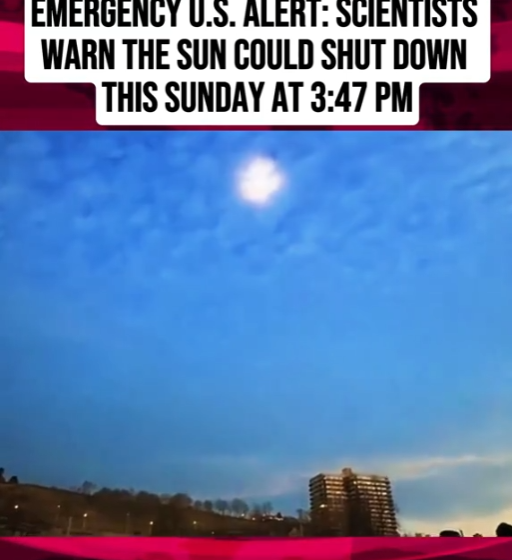
A dramatic “Breaking News” graphic is racing across social media, warning of an Emergency U.S. Alert that claims scientists say the Sun could shut down this Sunday at exactly 3:47 PM. The image shows a glowing orb in a blue sky, bold red banners, and urgent typography designed to stop scrollers cold. Within minutes, the post ignited fear, confusion, and heated debate, leaving millions asking the same question: Is this real, or is it another viral hoax?
The claim spread like wildfire—shared in group chats, reposted on pages hungry for clicks, and stitched into short videos with ominous music. Comment sections filled instantly with reactions ranging from disbelief to outright panic. Some users began asking if they should prepare for total darkness, while others joked about canceled plans and end-of-the-world vibes. But behind the shock factor lies a crucial reality check.
Experts say the idea of the Sun “shutting down” at a precise minute is scientifically impossible. The Sun is a massive nuclear furnace powered by fusion reactions that have burned steadily for billions of years. It doesn’t have an on/off switch, and it certainly doesn’t stop at a scheduled time like a TV broadcast. Even major solar events—like solar flares or coronal mass ejections—don’t turn the Sun off. They can disrupt satellites, power grids, or radio signals, but they do not plunge Earth into instant darkness.
So where did this alarming post come from? Digital analysts point to a familiar pattern: sensational wording, exact timestamps, and “Emergency Alert” language crafted to maximize shares and reactions. These elements are common in viral click-bait designed to trigger fear and urgency. Adding a specific time like “3:47 PM” makes the story feel official and credible—even when no verified source is cited.
Real scientific warnings look very different. When space agencies issue alerts, they reference observable data, probabilities, and clear impacts—often with cautious language. They don’t announce cosmic catastrophes with meme-style graphics or vague claims attributed to unnamed “scientists.” In this case, no recognized space agency, observatory, or research institution has issued any warning remotely resembling the viral claim.
That hasn’t stopped the post from racking up millions of views. Algorithms reward engagement, and fear travels fast. As people argue in the comments, the content keeps spreading—proving once again how easily dramatic visuals can overpower critical thinking.
The takeaway? Before sharing posts that predict apocalyptic events, pause and check reliable sources. Look for official statements, named experts, and reputable outlets. If something claims the Sun will “shut down” on a schedule, that’s a red flag .
For now, the Sun isn’t going anywhere. Sunday will arrive, clocks will tick past 3:47 PM, and daylight will continue as it always has. The real emergency isn’t a cosmic blackout—it’s how quickly misinformation can eclipse the truth.