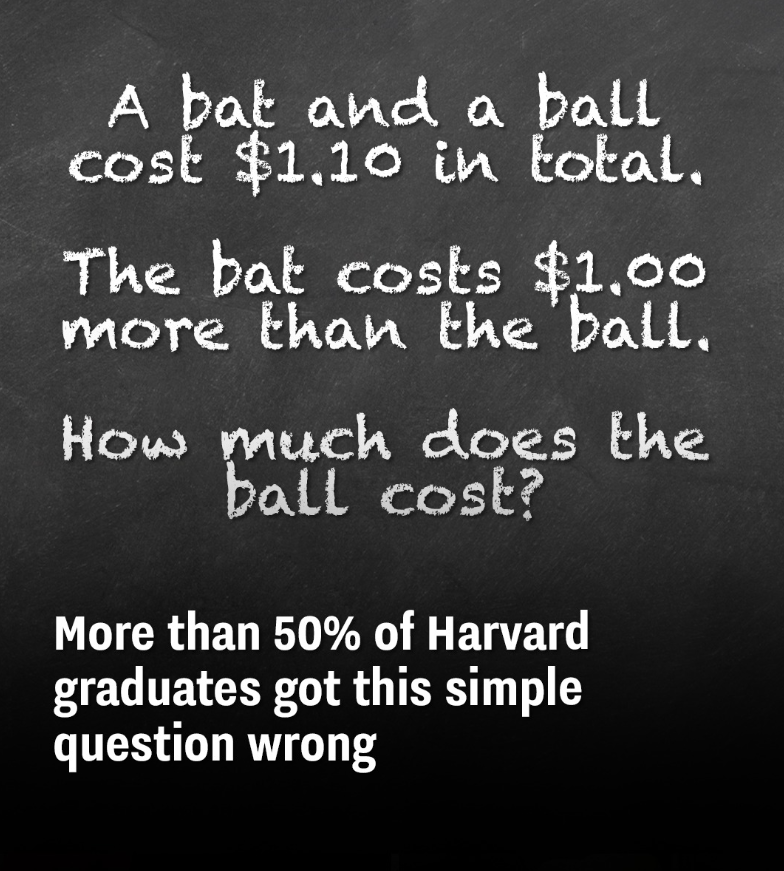
A bat and a ball cost $1.10 in total.
The bat costs $1.00 more than the ball.
Simple… right?
Most people don’t even pause.
They blurt out 10 cents and move on.
In fact, studies show more than 50% of Harvard graduates gave that exact answer.
But here’s the catch — and this is where the brain trips itself up.
Let’s slow it down.
If the ball cost 10 cents,
then the bat would cost $1.10 (because it’s $1 more).
But now add them together:
$1.10 (bat) + $0.10 (ball) = $1.20
That’s not the total we were given.
So the “obvious” answer is wrong.
Now let’s actually solve it properly.
Assume the ball costs x dollars.
Then the bat costs x + $1.00.
Add them together:
x + (x + 1.00) = 1.10
That simplifies to:
2x + 1.00 = 1.10
2x = 0.10
x = 0.05
The ball costs 5 cents.
The bat costs $1.05.
Together?
Exactly $1.10.
This question isn’t about math — it’s about how the human brain works.
Our minds love shortcuts.
They jump to answers that feel right instead of checking if they are right.
That’s why incredibly smart people get this wrong — not because they can’t solve it, but because they don’t stop to question the first answer that pops into their head.
So next time you see a “simple” problem, remember this one.
Sometimes the hardest part isn’t the math…
it’s slowing down enough to think.