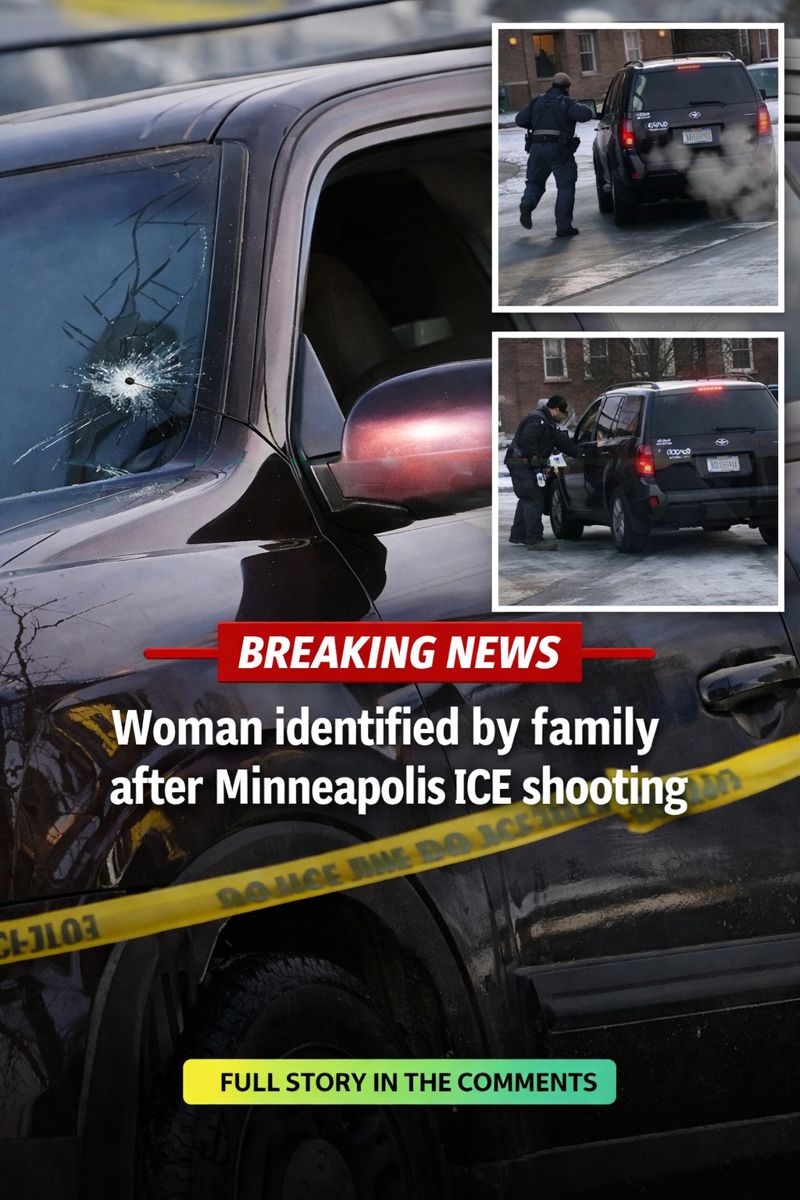
In the days after the shooting, Renee Nicole Good’s life has been flattened into a grainy video clip endlessly replayed online and a few charged sentences traded across political panels. Her name is now invoked in arguments about law enforcement, federal authority, and public safety. But behind the headlines was a 37-year-old woman whose life was defined by ordinary tenderness rather than controversy—small, human details that rarely survive the news cycle.
Renee wrote poems late at night, sometimes scribbling lines she never intended to share. She played the guitar, “badly,” she joked, but with enthusiasm and no embarrassment. Music, even imperfect, brought her calm. Most nights ended the same way: reading or talking quietly with her little boy before tucking him into bed. That ritual—so unremarkable to the outside world—has now been violently cut short. A child who has not yet finished elementary school has lost both parents, his life fractured before he had the language to describe what grief feels like.
Her mother remembers a daughter who always gravitated toward care work, drawn to helping professions not because they paid well but because they mattered. Renee believed in building safety through compassion, not force. She moved to Minneapolis with her wife to create a life that felt gentler, more intentional—a place where love, community, and stability could take root. That dream ended a few blocks from home, in seconds filled with gunfire, sirens, and confusion.
Officials say the ICE agent involved acted in self-defense, claiming her SUV clipped him during the encounter. The explanation is procedural, precise, and detached. To Renee’s family, those words ring hollow. They do not hear justification; they hear fear. “She was probably terrified,” they say, imagining her final moments not as a threat, but as a woman caught in panic, surrounded by flashing lights and authority she did not understand or expect.
What remains after the statements and press briefings is a child suspended between households, routines, and futures that suddenly feel unstable. Grief arrives in unpredictable waves—sometimes as tears, sometimes as silence. Adults around him struggle to answer questions they themselves cannot resolve. How do you explain a death that has become political before it has even been fully mourned?
The neighborhood, too, carries the weight. Residents replay the moment over and over, not just on screens but in memory. The intersection where it happened feels altered, charged with meaning. People argue about policy while quietly acknowledging a deeper discomfort: the uneasy place where federal power collides with human fragility, where procedures meet panic, and where irreversible decisions are made in seconds.
Renee’s story resists easy framing. She is neither a slogan nor a statistic. She was a daughter, a partner, a mother, a woman who believed care could be an act of resistance in a harsh world. Her life cannot be summarized by the circumstances of her death, yet that is how she risks being remembered.
As debates rage on, her absence speaks louder than any argument. A guitar sits untouched. Poems remain unfinished. A bedtime routine has ended forever. And her story lingers as an unresolved question—one that refuses to fade with the news cycle:
How many lives can become collateral before something finally changes?
Not in policy language or press releases, but in how society measures the cost of power when it intersects with fear, humanity, and irreversible loss.