It started as an ordinary family outing.
A peaceful walk through wooded trails.
Fresh air.
Sunshine filtering through the trees.
Children exploring nature.
Nothing seemed unusual until one mother noticed something small attached to her son’s leg after they returned home.
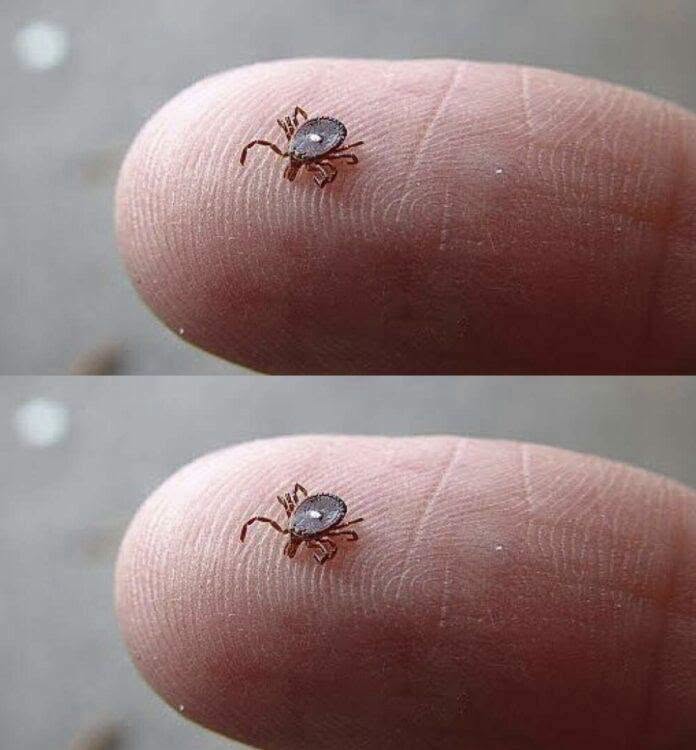
At first glance, it looked like an ordinary tick.
Tiny.
Dark.
Easy to overlook.
But there was one detail she had never seen before.
A single bright white spot on its back.
That tiny marking immediately caught her attention.
Unsure what it meant, she searched online.
What she discovered transformed a routine tick bite into an important lesson about one of the fastest-growing public health concerns associated with outdoor activities.
The insect was identified as a female Lone Star tick.
Unlike many other tick species, the adult female Lone Star tick has one distinctive feature that makes it relatively easy to recognize: a single white or silver dot located near the center of its back.
That small marking gives the species its common name.
Although tiny in size, the Lone Star tick has attracted increasing attention from researchers and public health officials in recent years because of the diseases and medical conditions it may be associated with.
Historically, many people learned primarily about deer ticks because of their connection to Lyme disease.
However, experts emphasize that different tick species carry different health risks.
The Lone Star tick is generally not considered a primary carrier of Lyme disease, but it has been linked to several other illnesses and conditions that deserve attention.
Perhaps the best-known is alpha-gal syndrome.
Alpha-gal syndrome is an unusual allergic condition that develops in some people after being bitten by certain ticks, including the Lone Star tick.
Researchers believe compounds introduced during the bite may trigger an immune response that causes the body to react to alpha-gal, a sugar molecule naturally found in most mammals.
As a result, some individuals develop an allergy to red meat and certain mammal-derived products.
For many people, the idea sounds almost unbelievable.
How could a tick bite lead to an allergy to beef, pork, or lamb?
Yet physicians have documented increasing numbers of cases over the past decade.
Unlike many food allergies that trigger symptoms within minutes, alpha-gal syndrome often behaves differently.
Reactions may occur several hours after eating red meat.
That delayed response can make the condition difficult to recognize.
Symptoms vary widely.
Some people experience itching or hives.
Others develop stomach cramps, nausea, vomiting, or diarrhea.
In more serious cases, individuals may experience difficulty breathing or severe allergic reactions that require immediate emergency medical care.
Importantly, not everyone bitten by a Lone Star tick develops alpha-gal syndrome.
Most tick bites do not result in this condition.
Researchers continue studying why some people develop the allergy while others do not.
Even so, awareness remains important because early recognition can help people seek appropriate medical evaluation if symptoms develop.
The Lone Star tick has also been associated with several tick-borne illnesses, including ehrlichiosis and Heartland virus disease in certain regions.
Although these illnesses remain relatively uncommon, health officials encourage people to monitor their health after any tick bite, particularly if fever, fatigue, rash, or flu-like symptoms develop.
Fortunately, discovering a tick attached to the skin does not mean panic is necessary.
Medical professionals recommend removing attached ticks as soon as possible using proper technique.
The safest approach involves using fine-tipped tweezers to grasp the tick as close to the skin’s surface as possible.
The tick should then be pulled upward using slow, steady pressure.
Experts advise against twisting, crushing, burning, or applying substances such as petroleum jelly, nail polish, or essential oils in attempts to remove the tick.
After removal, the bite area should be cleaned thoroughly with soap and water or an appropriate antiseptic.
Hands should also be washed carefully.
Many healthcare providers recommend noting the date of the bite and monitoring for symptoms during the following several weeks.
If unusual symptoms develop, informing a healthcare professional about the recent tick exposure can assist with evaluation.
Prevention remains one of the most effective strategies for reducing tick bites.
Outdoor enthusiasts can lower risk by wearing long sleeves and long pants when walking through wooded or grassy areas.
Light-colored clothing may make ticks easier to spot.
EPA-approved insect repellents containing ingredients such as DEET or picaridin may also help reduce exposure when used according to label instructions.
After spending time outdoors, performing a careful tick check is strongly recommended.
Ticks commonly attach behind the knees, around the waist, under the arms, around the ears, along the hairline, and other warm areas of the body.
Parents should check children carefully, and pet owners should also inspect dogs and other animals that may carry ticks into the home.
Prompt removal reduces the likelihood of certain tick-borne infections.
Many people are surprised to learn that tick populations have expanded into areas where they were once uncommon.
Changes in wildlife populations, climate conditions, and habitat have contributed to the spread of several tick species across portions of the United States.
As a result, public awareness has become increasingly important.
The goal is not to discourage outdoor recreation.
Nature offers enormous physical and mental health benefits.
Hiking, camping, gardening, and family walks remain wonderful activities.
The key is understanding potential risks and taking simple precautions.
In the end, the mother’s discovery became more than an unsettling surprise.
It became an educational moment.
A tiny white spot on an equally tiny tick revealed information that many families have never heard before.
Most tick bites will never lead to serious illness.
Most outdoor adventures end with nothing more than good memories.
But recognizing the Lone Star tick—and knowing how to respond appropriately—can make an important difference if exposure occurs.
Sometimes the smallest discoveries carry the biggest lessons.
And in this case, one tiny white dot serves as a reminder that a little knowledge can go a long way toward protecting the health of the people we love most.