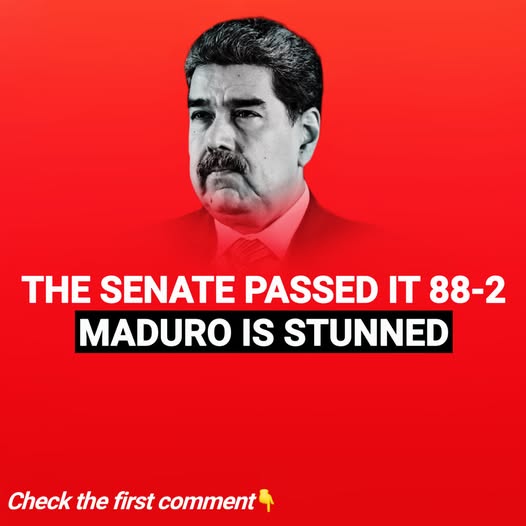
In early January 2026, the dramatic removal of Venezuelan President Nicolás Maduro from power through a swift and highly controversial U.S. military operation captured the world’s attention — and plunged Washington into a fierce debate over constitutional authority, executive power, and America’s role abroad. What began with headlines dominated by explosive footage and international reaction quickly shifted to questions about whether the president had the legal authority to order such an operation without explicit congressional authorization.
On January 3, 2026, U.S. forces launched what was described as Operation Absolute Resolve, a meticulously planned military strike that resulted in the capture of Maduro and his wife, Cilia Flores, in Caracas. The former Venezuelan leader and his spouse were then flown to the United States to face federal charges, including allegations of narcoterrorism — charges Maduro has denied. The operation involved elite U.S. Army Special Operations units, support from naval and air force assets, and was executed under what the administration characterized as a targeted law enforcement action with military backing.
The Trump administration defended the mission as a necessary step in confronting drug trafficking networks and regional instability, asserting that Maduro’s regime posed a threat to U.S. national interests. President Trump went so far as to suggest that the United States might maintain control over Venezuela’s vast oil reserves and “run” aspects of the country’s governance until a stable transition could be achieved.
However, many lawmakers — both Democrats and some Republicans — were alarmed by the apparent lack of congressional authorization for the military action. Under the U.S. Constitution, the power to declare war and authorize sustained military engagements rests with Congress. Yet in the weeks leading up to and following the operation, lawmakers pushed for resolutions aimed at reasserting this authority, arguing that the president had overstepped constitutional bounds.
Senator Tim Kaine (D-Va.), a longtime advocate for reinforcing legislative oversight of military action, announced plans to force a Senate vote on a War Powers Resolution. His effort was not about supporting or opposing the U.S. stance toward Venezuela per se, but about clarifying whether future military operations could proceed without Congress’s explicit consent. The move drew support from a bipartisan group of legislators who worried that repeated executive action without legislative oversight could erode constitutional checks and balances.
Critics of the administration’s approach argued that requiring congressional approval, even in urgent scenarios, reinforces democratic accountability and prevents unilateral decisions that could escalate into prolonged conflict. Supporters of the president countered that requiring such approval could hinder swift responses to fast-moving threats, contending that leadership must retain flexibility in matters of national security and foreign policy.
The Senate’s debate over war powers has seen mixed results. Previous attempts to pass resolutions restricting the president’s ability to conduct military action in Venezuela without congressional approval were blocked, with lawmakers voting largely along party lines. Yet the issue remains unresolved, with fresh proposals continuing to surface as the debate evolves. Senator Schiff+1
Public reaction in the United States has been sharply divided. Polls suggest that while a significant portion of Republicans supports the military intervention, many Americans across the political spectrum believe that Congress should have had a more direct role in authorizing the operation. Concerns about over-involvement abroad, and questions over whether the intervention will help or harm Venezuela’s future, have further complicated the national conversation. TIME
Internationally, the operation ignited widespread criticism. The United Nations, numerous governments, and global legal experts raised concerns about sovereignty, legality under international law, and regional stability. Some nations condemned the action as a violation of global norms governing the use of force, highlighting that the U.S. did not secure broader international backing before its mission. Reuters
As the controversy continues, the focus in Washington has shifted from only what the military action achieved — the removal of Maduro — to how and under what authority it was carried out. The war powers debate now sits at the intersection of constitutional law, executive authority, and U.S. foreign policy, with implications far beyond Venezuela.
At stake is not just the future of U.S. engagement in Latin America, but whether the constitutional balance between Congress and the presidency can withstand pressures in a world where military power is global, fast, and far-reaching.